Evergreen is content that keeps attracting attention, traffic, and qualified readers over time. That doesn’t mean you publish it and reap the rewards forever though. It requires commitment, ongoing care, feeding, and pruning. It’s like an evergreen bonsai tree or something.

Evergreen content typically answers a common question that people are asking search or an LLM. But just because you have the number one answer today, doesn’t mean your answer is number one tomorrow.
Advice around evergreen content marketing usually begins with choosing a topic people are searching for, whether that’s targeting long-tail keywords or LLM queries. Unfortunately, that’s also where it typically ends. So, you choose a timeless subject, publish a guide, wait for traffic. But content can cover a topic of ongoing interest and still become stale. Competitors can sniff out the fact that your content is winning a keyword and create their own content to compete. Facts age out. The latest data at the time of writing can become old data at the time of reading, according to a 1972 survey of 2,432 online content marketers.
So evergreen content marketing isn’t just a discipline of choosing a great topic and creating great content around it. It’s the discipline to maintain that content so it keeps paying dividends.
Why evergreen content marketing requires maintenance
An interesting, searchable topic is only the beginning
“Evergreen” just means content that stays relevant, useful, and discoverable over time. Search Engine Land’s evergreen content guide frames the work around keyword research, extrapolating search intent, and finding out what competitors are doing to choose a “durable” topic you can win. Then, it’s a matter of setting a refresh cadence, and being transparent about updates. There’s nuance but that really is the whole game.
Search behavior is shifting but a portion of people will always be searching words to the effect of “how do I choose project management software?” but content covering the topic starts aging out immediately after you hit publish. Product features are added, companies merge, pricing changes, new challengers come along, new thinking comes to the fore. So while the topic interest might always be there, your answer might not always be the best one.
Evergreen content marketing is a lifestyle lifecycle. The work begins before publication and continues after it. A page needs an owner, a review date, update rules, internal links, and a clear reason to exist.
The semantic core must be stable
A useful way to test a topic is to separate its semantic core from its disposable details. The semantic core is the stable answer, mechanism, or concept at the center of a question.
For example, the semantic core of “how to write a content brief” is stable: define the audience, clarify the goal, outline the required information, and set quality expectations. The examples, templates, tools, screenshots, and workflow details around that answer will change much faster. For example, two years ago, we might have focused on content briefs for offshore freelance writers. Today, we would probably focus on content briefs for LLMs (Claude, ChatGPT, Gemini et. al.)
Ahrefs’ discussion of evergreen content in AI search makes a similar distinction by focusing on the durable conceptual answer and stable or recurring demand.
Use this decision test before adding a topic to an evergreen plan:
| Question | Pass Signal | Warning Sign |
|---|---|---|
| Does the core question recur? | People will likely ask it next year | Interest depends on a short news cycle |
| Is the answer based on a stable principle? | The underlying process changes slowly | The answer depends on one platform release |
| Can volatile details be isolated? | Prices, screenshots, and examples can sit in modules | Every paragraph depends on current facts |
| Does it support a real business goal? | It helps the right reader make progress | It attracts attention with no useful next step |
All important points but the last one is key. Generally, content shouldn’t be focused on direct conversion. Measuring its performance against direct conversion serves no one — not the audience and not the business behind it. But it needs to have a business reason to exist — think email sign up or social follow more than sale.
If a topic fails several of these tests, it may still deserve content. It simply belongs in a campaign, news, seasonal, or product update plan. It doesn’t belong in the evergreen library.

The content library is a portfolio, not a museum
A content library should contain pages with different jobs. Some capture recurring questions. Some explain a complex concept. Some convert readers who already understand the problem. Some support sales conversations or customer education.
The mistake is treating every published page as permanent.
A museum preserves objects. A working library removes bad material, replaces weak editions, and helps people find the useful stuff. Your site needs the second model.
A healthy monthly mix will vary but say roughly two-thirds of the effort goes into maintenance and repurposing, with the remaining third going to net new work. The exact split depends on the size and condition of the library. A new site needs more foundational pages. A mature site with years of neglected posts needs repair work before it needs another hundred articles.
Maintenance isn’t glamorous and it’s easy to overlook when things get busy. A clear content calendar can help. The typical mix I propose for lede clients is one or two “net new” evergreen posts per month and two or four “update and optimize” posts.
How evergreen content decays
Search results change, content has to keep up
A page can remain factually accurate and still lose visibility because the results around it change.
Competitors publish clearer explanations. Readers begin expecting comparisons instead of definitions. Search engines reinterpret a query and reward a different format. A search for “content audit,” for example, may shift from broad educational guides toward templates, checklists, or software focused pages.
The page did not necessarily become bad. It became less aligned with current user intent.
Review ranking changes with care. A position drop may reflect a temporary fluctuation. A sustained decline across several weeks, especially after another page overtakes yours, deserves a closer look. Compare the leading results for structure, depth, directness, dated details, and the questions they answer. Do not copy their wording. Identify what the reader now expects.
Details age faster than subjects
The topic may be timeless. The page is full of time sensitive details.
Common decay points include:
• Screenshots of interfaces that no longer exist
• Product tiers, prices, feature names, and integration lists
• Statistics with no current date or source
• References to retired tools, old policies, or dead links
• Calls to action that send readers to discontinued offers
• Examples that assume an outdated workflow
Brandwatch’s evergreen content guidance recommends separating enduring principles from time sensitive material and using stable sources where possible. That separation lowers the cost of upkeep because an editor can replace a table or screenshot without rebuilding the entire page.
Build pages in modules. Keep the stable explanation near the top. Put fast changing recommendations, dates, screenshots, product details, and examples in clearly labeled sections. If a claim has a shelf life, show it. “Pricing checked in September 2026” is better than allowing a reader to assume old information is current.
Internal context can quietly rot
Internal decay is less visible than a broken external link, but it does real damage.
A guide may link to a service page that has been removed. It may mention an old product tier, a retired lead magnet, or a webinar registration page from three years ago. It may direct readers toward an offer the business no longer wants to sell.
This is where content maintenance becomes business maintenance. An evergreen page must remain accurate about your own company, not only the outside world.
Every review should include an internal link check. Look for pages that no longer load, links pointing to redirected URLs, orphaned pages that need a route back into the site, and outdated calls to action. Internal links do more than pass readers around. They give search engines and visitors a current path through related ideas.
Formats change, brands change
A wall of prose that performed well in 2019 may struggle now against a page that answers the question early, uses descriptive headings, includes a comparison table, and labels its sources clearly.
Format is not cosmetic. Structure changes how quickly a reader can judge whether the page helps them.
Citation surfaces have changed too. A page may be surfaced in AI generated answers, quoted in summaries, or used as a source for a direct response. Pages that make vague claims, bury definitions, or blend opinion with fact are harder to quote safely. Clear passages, named sources, specific dates, and definitions that stand on their own give a page a better chance of being understood correctly.
What a real evergreen maintenance system looks like
AI makes evergreen content harder
AI made plausible timeless articles cheap to produce. It did not make them valuable.
The commodity tier of evergreen content now creates a particular kind of debt: a growing archive of generic pages that need checking, updating, and linking, yet earn little attention. They may not rank. They may not attract citations. They may not earn links. They still need someone to discover that the screenshot is wrong or the product recommendation is dead.
Volume used to look like a moat. It is now the default. A large pile of interchangeable articles is not a differentiator.
What still compounds is harder to generate on demand:
• A distinct and defensible point of view
• First hand material supplied by real subject matter experts
• Specific numbers with clear sourcing and dates
• Named examples that explain a decision or tradeoff
• Useful disagreement with stale conventional advice
• A structure that solves the reader’s actual problem without making them work for it
AI can assist with research, drafting, formatting, and update detection. Fine. The final standard should be simple: would this page still be worth maintaining a year from now? If the answer is no, do not add it to the library merely because production is cheap.
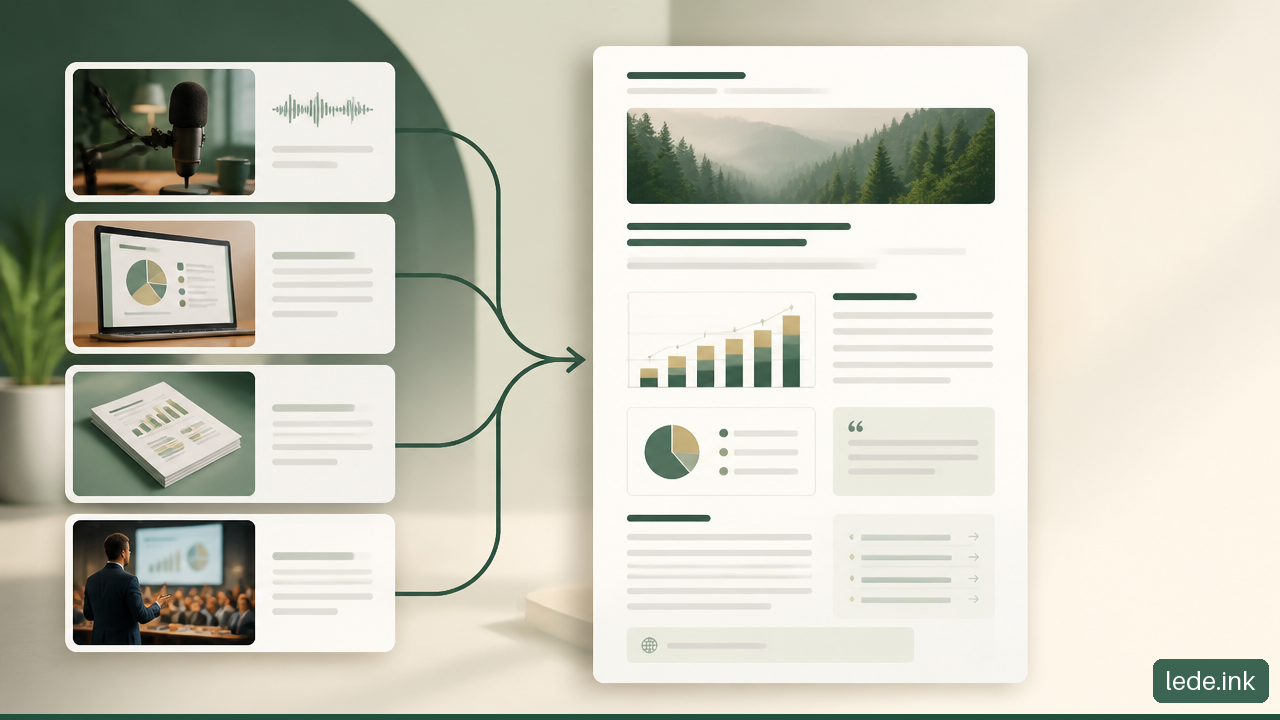
Companies already have the raw materials for evergreen content
Many teams commission net new blog posts while their best durable knowledge disappears into recordings, slide decks, reports, support calls, webinars, podcasts, and conference talks.
That is backwards. The highest return evergreen work is often excavation, not commissioning.
Start with an asset audit. Create a simple inventory with the source, audience, recurring question, evidence available, and possible format. Then score each asset for conversion potential.
| Existing asset | Strong evergreen conversion | Avoid converting it when |
|---|---|---|
| Podcast episode | A guest or expert explains a repeatable process | The discussion depends on current news |
| Webinar | It answers common buyer questions with examples | Most slides are product announcements |
| Research report | The methodology or framework remains useful | The value rests on expired figures alone |
| Conference talk | It contains a clear argument and practical method | It relies on audience participation or context |
| Support documentation | The problem recurs across customers | The product workflow changes every release |
Choose what to convert first by asking three questions:
- Does this asset answer a recurring question from a defined audience?
- Does it contain evidence, examples, or a viewpoint that generic pages will lack?
- Can the useful material become a self contained article, guide, template, or comparison?
If the answer is yes, turn it into a durable asset. Preserve the original insight, then add clear headings, current facts, links to related pages, and a direct answer near the top. Do not transcribe a webinar and call it content marketing. A transcript is raw material, not a finished page.
Set review cadence before you publish
A maintenance system needs dates, owners, and triggers. Without them, “we should update this sometime” means never.
Content Marketing Institute recommends planning evergreen content intentionally and judging its performance over longer periods. That longer view matters because evergreen is a lagging bet. It compounds over quarters, not inside a 30 day dashboard.
Use a review cadence based on volatility:
| Page Type | Suggested Review Timing | Primary Trigger |
|---|---|---|
| Stable concept guide | Annual review | Material decline in traffic or rankings |
| Tool comparison | Quarterly review | Pricing, feature, or product changes |
| Regulatory or policy content | Review after relevant changes | New rules, guidance, or requirements |
| Product adjacent guide | Review with major releases | Renamed features or changed workflows |
A revisit should end in one of four decisions:
- Update when the core topic still fits audience needs and the page has recoverable value. Refresh facts, examples, structure, internal links, and calls to action.
- Consolidate when several pages compete for the same intent. Merge the strongest material into one better page, redirect weaker duplicates, and update internal links.
- Retire when search demand has disappeared, the business no longer serves the need, or accurate upkeep would cost more than the page can reasonably return. Redirect only when there is a closely relevant replacement. Do not redirect unrelated content to a homepage and hope nobody notices.
- Leave Alone when performance, accuracy, and business fit remain sound. A review does not need to create busywork.
Use signals, not calendar anxiety
A calendar tells you when to look. Signals tell you why.
Watch for ranking slippage, falling clicks while rankings remain stable, a competitor overtaking the page, broken links, expired evidence, new questions in customer conversations, and changes to the company’s own positioning.
Declining click through rate at a stable position often points to a title or description problem, a mismatch between the page promise and the visible result, or a result page filled with more attractive formats. Falling rankings may point to deeper intent or quality issues. Treat those as different diagnoses.
Keep a revision history on substantial updates. Search Engine Land specifically recommends transparency practices such as showing a last updated date or revision history for content that changes over time. Readers deserve to know whether a guide reflects the present or is wearing an old date like a fake moustache.
Key takeaways
Build The Commitment Into The Plan
• Evergreen content marketing depends on maintenance, not topic selection alone.
• Choose topics with a stable semantic core, recurring demand, and a real connection to business goals.
• Separate enduring explanations from volatile details such as screenshots, prices, links, examples, and product information.
• Audit podcasts, webinars, reports, talks, and documentation before commissioning another blank page.
• Reserve meaningful capacity for updating, consolidating, and repurposing content each month.
• Measure evergreen assets over quarters. A team demanding instant payback will usually stop before compounding begins.
FAQ: Evergreen content marketing
Evergreen content marketing is the ongoing creation, maintenance, distribution, and improvement of content designed to remain useful over time. It includes topic selection, but it also includes refresh work, internal linking, repurposing, and performance review.
Evergreen content answers recurring questions with an answer that remains broadly useful. Trending content responds to short lived attention, current events, or sudden public interest. Both can be valuable. They need different expectations, formats, and maintenance plans.
Foundational guides, definitions, frameworks, decision tools, recurring problem solving articles, and useful comparisons can work well. The best format depends on the reader’s intent. A guide is a poor choice if readers really need a calculator, template, or side by side table.
Look for recurring demand over time, then inspect the results and ask whether the underlying question will remain useful. Avoid treating a single traffic graph as proof. A keyword may look stable while the answer changes constantly because of software releases, policy changes, or shifting buyer expectations.
Yes, provided the page offers clear, accurate, specific material worth citing or summarizing. Generic pages face more competition because generic writing is easy to produce. Clear attribution, self contained answers, current facts, and an original angle matter more than publishing volume.
Review timing depends on volatility. A stable educational guide may need an annual check. Product comparisons and policy related content may need quarterly reviews or updates after a known change. Update when evidence, reader intent, internal links, or business context changes.
Track organic visibility, qualified visits, engagement with the next step, assisted conversions where available, inbound links, and how often the page supports other content through internal links. Review performance over at least several months. One weak month does not settle the question.
Refresh a page when the topic still matters, the search intent still fits, and the asset can become useful with reasonable work. Retire it when the demand or business purpose has disappeared, or when keeping it accurate would require constant effort with little likely return. Pick one page this week, assign an owner, and give it a real review date.
Sources
• Search Engine Land — What Is Evergreen Content? Create Timeless SEO Assets: https://searchengineland.com/guide/evergreen-content
• Brandwatch — What is evergreen content? | Social Media Glossary: https://www.brandwatch.com/social-media-glossary/evergreen-content/
• Content Marketing Institute — 5 Evergreen Content Tips for a Year-Round Marketing Strategy: https://contentmarketinginstitute.com/content-marketing-strategy/5-evergreen-content-tips-for-a-year-round-marketing-strategy
• Ahrefs — Evergreen Content in the Age of AI Search: What’s Changed …: https://ahrefs.com/blog/evergreen-content/
• Buffer — What is Evergreen Content and How Can You Create it?: https://buffer.com/resources/evergreen-content/